
Subscription Price Scenario Calculator
Compare subscription price, discount, fee and churn assumptions in a simple monthly revenue scenario.

Pricing decisions are not solved by one number. This calculator helps you compare simple monthly scenarios using subscriber count, subscription price, discounts, fees and churn assumptions.
Compare creator subscription prices
Enter your own subscribers, price, discounts, platform fee and assumed monthly cancellations.
Your modeled subscription revenue
Revenue after platform fees is not profit. Taxes, refunds and other costs are excluded.
Compare three subscription prices
Edit each price to compare the same starting audience, discount, fee and cancellation assumptions. This does not predict how price changes demand.
| Monthly price | This month after fee | Next month after fee |
|---|---|---|
| — | — | |
| — | — | |
| — | — |
Next month assumes no new subscribers, a fixed fee and discount, and the cancellation rate entered. Fractional subscribers are mathematical expected values.
Use scenarios, not predictions
A higher price can increase revenue per subscriber while changing demand or retention. A discount can reduce effective price while potentially changing conversion. This tool does not model demand; it only shows the arithmetic of assumptions you provide.
What to compare
Run several realistic scenarios and compare effective price, gross revenue, estimated net revenue and retained subscriber count. Keep the inputs based on your own historical data whenever possible.
Pricing should match positioning
Price is part of a larger profile promise. Content frequency, exclusivity, creator positioning, audience expectations and additional paid offers all influence how a price is perceived.
Use this calculator as a decision model, not a prediction
The subscription price calculator models monthly revenue arithmetic from subscriber count, price, average discount, platform fee and churn. The result is only as useful as the assumptions you enter. Buzz Crafter calculators are designed to make those assumptions visible so you can test scenarios, replace estimates with measured data and understand which variable changes the outcome.
What the pricing model includes
| Input | Purpose |
|---|---|
| Paying Subscribers | Starting number of paying subscribers in the monthly scenario. |
| Monthly Subscription Price | List price before the entered average discount. |
| Average Discount | Simple reduction used to estimate an effective average price. |
| Platform Fee | Percentage deducted from modeled gross subscription revenue. |
| Monthly Churn | Share of starting subscribers assumed not to remain after the period. |
What the model intentionally leaves out
The calculator does not estimate demand. It cannot tell you whether raising or lowering price will change the number of people willing to subscribe. It also excludes tips, paid messages, bundles, renewals beyond the modeled period, refunds, taxes and other monetization unless you calculate them separately.
Compare price scenarios with the same baseline
If you want to understand the arithmetic effect of price, keep subscriber count constant first. Compare several prices while holding discounts, fees and churn constant. Then run a second set of scenarios where you explicitly change subscriber count or churn. This prevents multiple assumptions from moving at the same time.
Effective price matters more than list price
If promotions or discounts are common, list price can overstate realized subscription revenue. Use an average effective discount based on actual sales where possible. For agencies, calculate this creator by creator rather than assuming one discount behavior across the entire roster.
Churn changes the value of acquisition
A creator who retains subscribers longer can justify a different acquisition cost than one with high churn. The calculator shows only one monthly step, so use retention data alongside the Promotion ROI Calculator when thinking about paid traffic economics.
Pricing is also a positioning signal
Visitors interpret price together with profile presentation, content expectation, posting frequency, niche, free previews and promotional offers. A pricing test should therefore document what else changed during the test period.
A simple pricing experiment
- Record the current effective price, conversion and churn for a defined period.
- Choose one controlled pricing change.
- Keep the profile and acquisition channels as stable as practical.
- Measure conversion and churn for a comparable period.
- Compare net revenue rather than subscriber count alone.
Related resources
- Creator Profile Optimization Guide
- Improve creator profile conversion
- Promotion ROI Calculator
- Buzz Crafter data methodology
Creator subscription prices: what changes when you raise or lower your price?
Use the comparison above to explore pricing scenarios for OnlyFans, Fansly, Fanvue, F2F, FansyMe, MYM and other subscription-based creator businesses. Platform features and subscription terms vary. These are calculations, not actual sales data or demand forecasts.
Worked example: 100 paying subscribers
With 100 subscribers, a $9.99 list price, 10% average discount and an example 20% platform fee, modeled current-month revenue after that fee is $719.28. If 15% cancel and no new subscriber arrives, 85 subscriptions remain and the modeled next-month amount after the same discount and fee is $611.39. Taxes, refunds, tips and other costs are excluded.
Why compare three prices?
Start with the same number of paying subscribers and change only the price. This isolates the arithmetic effect on revenue per subscriber. In real life, a higher price may affect conversions, renewals and new signups, none of which this tool predicts.
Understanding discounts, fees and cancellations
Effective price equals list price times (1 − average discount). This month's revenue after platform fee equals subscribers × effective price × (1 − fee). Next month uses the remaining subscriber estimate after the entered cancellation rate and assumes no new customers.
Frequently asked questions
Does the calculator recommend my best OnlyFans or Fansly price?
No. Use your own measured pricing, subscriber and renewal history when making decisions.
Does the next-month estimate include new subscribers?
No. It models cancellations only, with unchanged discount, price and platform fee.
Is revenue after platform fees my profit?
No. Taxes, advertising costs, refunds, content production and other expenses are not included.
Can I model advertising revenue too?
Use the Campaign Budget Calculator to explore visits and the Promotion ROI Calculator for modeled ad spend and subscription revenue.
Explore related creator resources
Browse resources →
Creator Campaign Tracking Worksheet
A reusable worksheet for recording campaign inputs, measured outputs, calculated rates, attribution notes and next-test decisions.
Read more →
Creator Content Distribution Checklist
A channel-by-channel workflow for adapting one creator content idea across search, social, communities, discovery sites and paid placements.
Read more →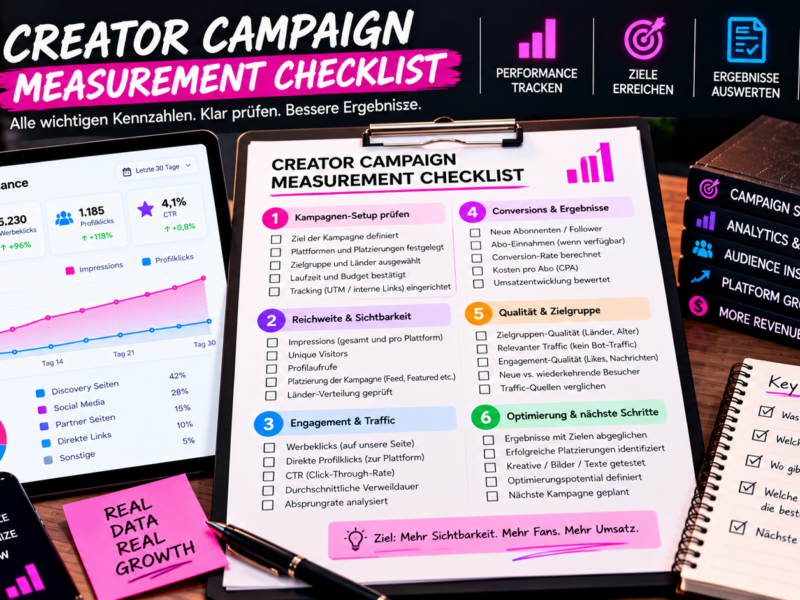
Creator Campaign Measurement Checklist
A reporting framework that separates delivery, traffic, destination outcomes, calculated metrics and attribution limits.
Read more →